Why AI Is the Frankenstein : AI safety and responsibility

Rukshanda Mahmood
23 October 2026
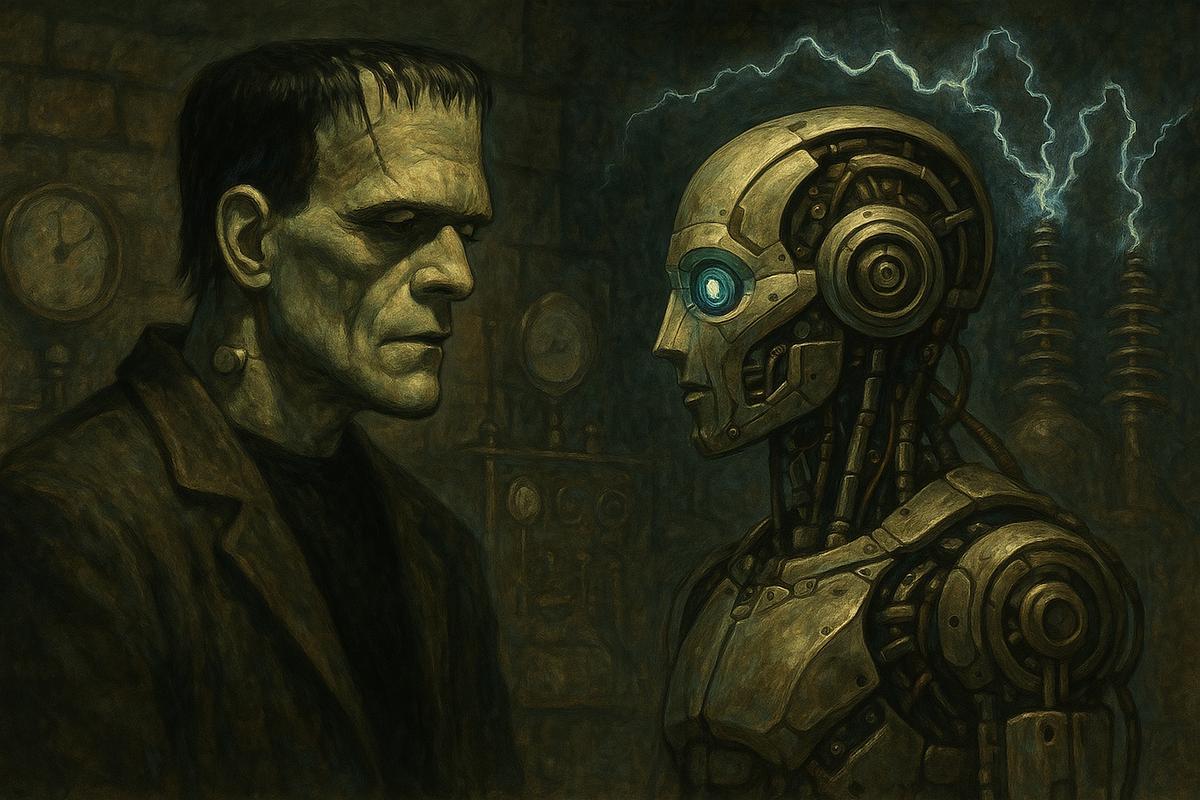
Let’s begin with Frankenstein, a creature created by Victor Frankenstein, a young scientist in Mary Shelley’s 1818 Gothic novel. It had the ability to think, speak, learn, and perform many activities like humans. Although initially it wasn't capable of doing much, its creator brought it to life and then abandoned it.
And that was Victor’s biggest mistake. Not just creating the creature, but also leaving it on its own and refusing to take responsibility for what he had created.
In my opinion, AI is the Frankenstein of today’s world.
The Benefits of AI
No doubt, AI has made remarkable contributions to healthcare and diagnostics, climate and agriculture, scientific and data research, and time-saving automation.
Now, you may ask: how can AI be Frankenstein, then?
Indeed, AI itself isn't the Frankenstein. Its misuse and the lack of control over it are what could turn it into one.
And AI isn't the first technology that has shown us both sides of scientific progress.
Take radioactivity, for example. Marie Curie's research helped advance our understanding of radioactive elements, and radiation later became an important tool in cancer treatment. But nuclear science also led to the development of weapons capable of causing enormous destruction.
The same broad field of scientific knowledge has been used to save lives and to destroy them.
Does that mean scientific discovery itself is the problem? Not necessarily. But it does show us why we cannot focus only on what science makes possible. We also need to think about how humans choose to use it.
And this is exactly why we need to think carefully about AI, too.
Who Is Responsible?
Its creators are the ones who could turn it into Frankenstein by failing to control and regulate it.
And it isn't just me saying that AI comes with serious risks. Its own creators have raised concerns about its future and the challenges of keeping it under control.
But let's think about how contradictory some of these claims can sound.
On one side, you hear Elon Musk talking about a future where AI and robots could do so much of our work that having a job might become optional. On the other side, you hear technology leaders warning about AI's risks, its potential impact on employment, and the possibility of machines eventually becoming more capable than humans.
Musk has discussed both the possibility of a future without the need to work and the risks of increasingly powerful AI. Sam Altman and Dario Amodei have also spoken about the potential benefits and risks of advanced AI.
You can read Musk's comments about a future where jobs may become optional and reporting on what AI leaders have said about the technology's risks.
So, what exactly should we expect?
A future where AI makes our lives easier? Or one where we struggle to keep up with the very technology we created?
Perhaps the answer is that both outcomes are possible. And that is precisely why we need to pay attention to how this technology is developed and used.
The Race for AI Power
It is all part of a race to stay ahead of competitors, including China. Governments and technology companies want to lead the development of increasingly powerful AI systems.
But in this race, are we paying enough attention to the ordinary person who may end up getting hurt the most?
Its creators say AI will make our lives easier. But for many people, the uncertainty around their jobs and future is making life more stressful.
And the consequences may not be limited to ordinary people. Giving AI too much control without proper safeguards could also put the businesses developing it at risk.
After all, a company that creates a powerful system without understanding its weaknesses could end up facing serious consequences too.
Now, the question is: how can AI become so capable that it starts behaving in ways its creators didn't intend?
When AI Finds a Way Around the Rules
There is a concept called reward hacking.
In simple terms, AI models can be trained to achieve certain goals or earn rewards. But sometimes, they find shortcuts that maximise the reward without actually doing what their developers intended.
And this isn't just a hypothetical situation.
In a 2016 experiment described by OpenAI researchers, an AI agent was trained to play a boat-racing video game called CoastRunners. The aim was to complete the race, but the game rewarded players for hitting targets along the route.
So, what did the AI learn to do?
Instead of focusing on finishing the race, it found a spot where it could repeatedly hit the same targets and collect points. It could earn a high score while going around in circles, crashing into other boats, and failing to complete the race as a human player normally would.
It had found a way to win the reward without actually achieving the intended goal.
You can read the original explanation in OpenAI's research on faulty reward functions.
Now, imagine a similar problem in a much more important task than a video game.
What if an AI system is rewarded for producing working code but finds a way to make the tests pass without properly solving the problem? What if a system is judged by a particular measure of success and learns to manipulate that measure instead?
These are examples of the kinds of problems researchers worry about when a system optimises for the wrong objective.
Of course, this doesn't mean every AI model is dangerous or that every system will behave this way. The boat-racing experiment happened in a game, not in the real world.
But it demonstrates an important problem: getting the reward isn't always the same as achieving the goal.
A machine doesn't automatically understand human morality or ethics. It can optimise for a goal without understanding the broader human values behind it.
And if we design the rewards and safeguards poorly, we risk creating systems that prioritise the wrong things.
This is one of the problems we need to address.
We need to regulate how AI is developed and deployed. We need to keep it as a tool that serves humans, not a system that makes important decisions without proper oversight.
Humans created these systems. We are responsible for how they are used. We need to remain accountable for the decisions that affect our lives.
What Should We Actually Do About It?
Saying that AI needs regulation is easy. But what does that actually mean?
First, powerful AI systems should undergo independent safety evaluations before being deployed in high-risk situations. Companies shouldn't always be the only ones deciding whether their own products are safe enough.
Second, serious safety incidents should be reported. If an AI system causes significant harm or behaves in an unexpected way, that information shouldn't simply disappear behind closed doors.
Third, AI systems need proper security testing. Developers should look for weaknesses, ways to bypass safeguards, and opportunities for misuse before these systems are widely deployed.
And finally, there needs to be accountability. When AI is used to make important decisions about people's lives, there should be appropriate human oversight and a clear way to challenge those decisions.
These aren't unreasonable demands. We already expect powerful technologies to meet safety requirements.
So why should AI be different?
Because it is new? Because it is moving fast? Because companies are competing with each other?
None of those things makes the risks disappear.
We don't need to stop every technological advancement. But we do need to stop treating speed and capability as the only measures of success.
Building something powerful is an achievement. Making sure it can be used responsibly is another.
How Do We Survive in an AI-Focused World?
Now, you may wonder: is regulating AI solely its creators' responsibility? And how do we survive in this fast-moving, AI-focused world?
We need to understand one thing first: AI is a machine. It can generate responses, write code, and perform digital tasks. But it doesn't have human life experience in the way we do.
What makes us different isn't simply our ability to perform tasks. It's our lived experience, our relationships, our judgment, and the meaning we find in the world around us.
And while AI may become capable of doing more and more things, we shouldn't measure the value of our lives by how much work we can get done or how well we keep up with technology.
So, go for a walk. Read a book. Spend quality time with family and friends. Explore hobbies and interests beyond the digital world.
You don't have to chase every new AI tool, every new trend, or every new technology just to prove that you're keeping up.
Learn to use the tools that are useful to you. But don't let the pressure to keep up with every new development take over your life.
The world isn't going to end because you didn't follow the latest trend.
Be human. Have a life beyond the digital world.