Loading...The AI Bubble Is Popping in China. Is America Next? What Developers Should Do Now | Digital Cheetahs
Tech News
The AI Bubble Is Popping in China. Is America Next? What Developers Should Do Now
Rukshanda Mahmood
28 October 2026
The technology is real. But is all the money pouring into it justified?
For years, AI has attracted billions in investment. Companies are racing to build data centres, buy chips, train models, and launch AI products. Investors don't want to miss the next big thing.
But there's a problem: AI revenue may not grow fast enough to justify the money being spent on it.
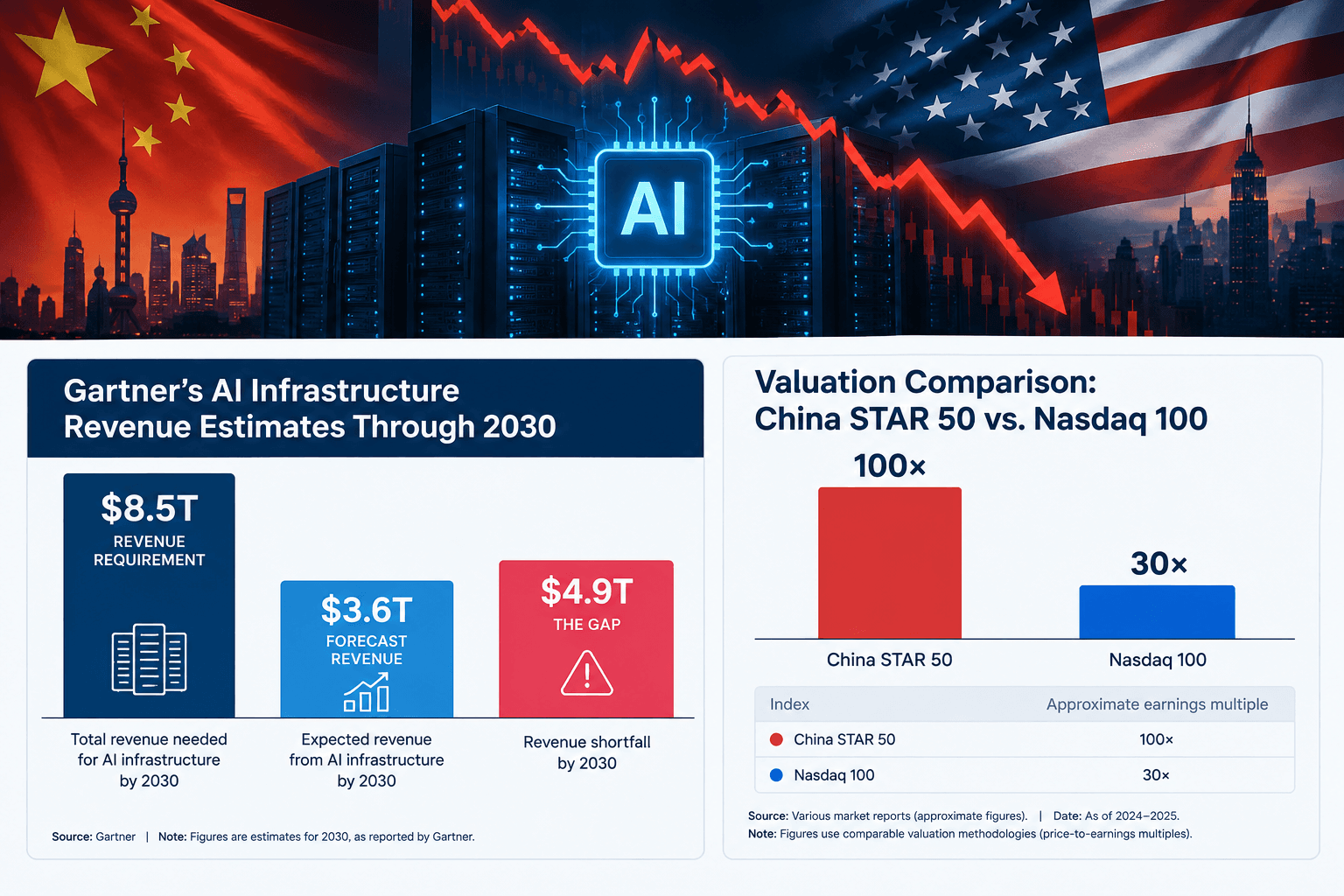
China is already showing what happens when enthusiasm meets reality. Its STAR 50 technology index has fallen around 40% from its July high, wiping out roughly $480 billion in market value. And despite that decline, the index still trades at around 100 times earnings, compared with approximately 30 times for the Nasdaq 100. Reuters' analysis of China's AI selloff explains why investors are questioning whether the boom can deliver sustainable profits.
So, is America next?
Not necessarily in the same way. The US risk runs through credit and capital-spending guidance first, equities second. If AI demand disappoints, heavily indebted infrastructure companies could face financing pressure, major technology companies could reconsider their spending, and stock valuations could come under pressure.
That is a risk scenario, not a guaranteed outcome. US stocks have not simply collapsed in response to China's correction, and the Nasdaq has recently rebounded.
And if you're a developer learning AI, there's something important here: a market correction doesn't mean the technology has failed. It means the businesses built around it may have to prove they can make money.
China's AI Bubble: What Happened?
China's AI boom attracted investors who expected rapid growth from semiconductor companies, robotics businesses, and other technology firms. Valuations climbed as investors priced in future success.
Then the market turned.
According to Reuters' October 26 report, the STAR 50 index fell around 40% in less than four months, wiping out approximately $480 billion in market value. The broader CSI 300 blue-chip index also fell around 20% from its June peak.
Tags:#AI bubble 2026#China AI bubble#US AI infrastructure spending#AI industry predictions 2026#AI developer skills#Future of AI development#AI engineering careers#AI investment risks
The reasons include stretched valuations, concerns about future AI demand, tax pressures, and the risk of restrictions on Chinese suppliers to data centres.
But here's the interesting part: even after the decline, the STAR 50 was still trading at roughly 100 times trailing earnings, compared with around 30 times for the Nasdaq 100.
A falling share price doesn't automatically make a company cheap. If investors were paying far more than a business could reasonably earn, the price might still have room to fall.
China isn't a perfect preview of America, either. Its market structure, government involvement, and financing conditions are different. But the correction offers a warning about what happens when expectations get too far ahead of earnings.
A technology can be revolutionary without every company associated with it becoming a successful investment.
America's AI Infrastructure Problem: $8.5 Trillion Needed, $3.6 Trillion Forecast
One of the strongest warnings comes from Gartner's October 14 analysis.
The research firm estimates that AI data-centre owners would need $8.5 trillion in cumulative revenue through 2030 to cover announced capital spending, financing costs, and a 12% return on invested capital.
Yet Gartner forecasts no more than $3.6 trillion in enterprise and consumer AI revenue attributable to AI data centres over that period.
That's a potential gap of $4.9 trillion.
According to Gartner's original announcement, more than $3.5 trillion of AI infrastructure spending could be exposed to impairment by the end of 2030 if current investment patterns continue.
There's an important distinction here. These are estimates, not confirmed losses. AI revenue could grow faster than expected, companies could slow their spending, or new business models could emerge.
Still, the numbers raise a serious question: can all this infrastructure generate enough money before the equipment becomes outdated and needs replacing?
Imagine building a factory with expensive machinery because you expect demand to explode. If demand arrives, the investment might pay off. But if customers don't spend enough, you're left with the bills even if the machinery itself works perfectly.
AI data centres face a similar challenge. They need paying customers and sustainable pricing, not just demand for computing power.
Gartner also expects more than 80% of neocloud providers to cease independent operations by 2030 because of cost pressure and a lack of differentiation. That doesn't necessarily mean all those companies will disappear; some may be acquired or consolidated.
The pressure is likely to be greatest on companies that must continually raise money to keep expanding.
The Debt Warning: CoreWeave, Credit Risk, and Interest Rates
This is where the AI investment story becomes more concerning.
Reuters reported on October 16 that CoreWeave bonds issued in June at a yield of 9.675% had fallen in price, pushing their yield to around 15% in October.
That is a significant change in the cost investors demand to hold the company's debt.
Credit default swaps, or CDS, are financial contracts that provide protection against a borrower defaulting. When the cost of that protection rises sharply, it can signal growing concern about the borrower's ability to meet its obligations.
Oracle has faced credit pressure as well, with S&P reportedly cutting its rating to BBB-, one notch above speculative-grade status. That doesn't mean a default is imminent. It does mean the company's credit position deserves attention as its financing needs grow.
And then there's interest rates.
On October 28, the Federal Reserve held its benchmark rate at 3.75%–4% in a 10–2 vote. Two officials dissented, preferring a quarter-point increase. The Fed also said inflation remained elevated. Read the Reuters report on the Fed's decision.
Higher rates don't automatically cause an AI crash. But when companies depend on borrowing to fund enormous infrastructure projects, expensive financing can make already difficult economics harder to justify.
Its analysis of 14 transactions since 2023 identified approximately $300 billion in equity investments and $650 billion in debt associated with $1.4 trillion in future revenue commitments.
The concern is that these financial relationships can reinforce one another. If an AI company struggles, its valuation may fall, its debt may become harder to service, and expected purchases from other businesses may not materialise.
That doesn't make a financial crisis inevitable. It does mean the risks may extend beyond one company.
The Bull Case: Why AI Isn't Going Away
Before we declare the entire AI industry doomed, let's slow down.
AI is already useful. Businesses are integrating it into software development, customer support, research, document processing, and other workflows. Demand for computing power remains substantial, and some of the largest technology companies have established businesses that can support long-term investment.
Alphabet's October 28 earnings announcement reported third-quarter revenue of $127.6 billion, up 25% year over year. Google Cloud revenue grew 103% to $30.7 billion, with the company citing demand for AI infrastructure and enterprise AI solutions.
That's meaningful evidence of commercial demand. It doesn't, by itself, prove that every AI infrastructure investment will earn a satisfactory return.
The distinction matters because strong demand and excessive investment can exist at the same time.
AI could follow a broad pattern similar to the internet boom: some businesses fail, some investors lose money, and useful technology continues to develop. History doesn't guarantee the same outcome, but it reminds us that a technology's long-term value and the price investors pay for it are two different questions.
A market correction could also make AI more affordable for smaller businesses and developers if computing costs fall and providers compete more aggressively. On the other hand, client budgets may tighten during a downturn, so cheaper technology doesn't guarantee more work.
The winners will need to show that their spending creates value.
What Should Developers Do Now?
I wouldn't abandon AI because of the possibility of a market correction. Instead, I'd focus on skills and products that remain useful even if investment slows.
The aim isn't to guess when a bubble will burst. It's to build a career that doesn't depend on the hype continuing forever.
1. Learn AI Engineering, Not Just Prompt Writing
Prompting is useful, but building production software requires much more.
Learn how to connect models to APIs, databases, and existing applications. Understand structured outputs, tool calling, retrieval-augmented generation (RAG), and agent workflows.
For TypeScript developers, this is a natural extension of existing web-development skills. Use schema validation to check that model outputs match the structure your application expects. Create a small evaluation set for each AI feature so you can test whether changes improve or damage its performance. Log the cost and latency of each request.
These aren't glamorous features. But they're part of the difference between a demo and software a business can depend on.
2. Avoid Locking Your Application to One AI Provider
Put model calls behind a provider-agnostic interface where practical. That way, you can change providers without rewriting your entire application.
Switching models still requires testing because their capabilities and outputs differ. But a flexible architecture gives you more options if prices change, services become unavailable, or a better model appears.
Don't build unnecessary dependence into your product.
3. Sell Business Results, Not the Word "AI"
Businesses don't pay just because something uses AI. They pay because it helps them solve a problem.
A rental company might want to reduce repetitive booking enquiries. A marketing agency might need a custom client dashboard. A logistics business might want to automate a manual reporting process.
These are concrete problems with outcomes you can measure.
Instead of promising that an AI agent will transform a business, identify a specific task, build a small solution, and test whether it saves time, reduces errors, or improves the customer experience.
You don't need to promise extraordinary results. You need evidence that the tool is useful.
4. Build for Reliability and Control Costs
A useful AI product needs more than a clever model.
It needs error handling, monitoring, testing, and a clear way to deal with uncertainty. If a model returns invalid data, your application should catch it. If an API fails, the system should handle the error rather than silently corrupting the workflow.
Keep track of model costs and response times. Test important changes against a consistent set of examples. For workflows that affect customers or business decisions, make sure a human can review uncertain cases.
A smaller, reliable system can be more valuable than a complicated agent that makes mistakes without anyone noticing.
5. Protect Your Freelance Income
AI startups can be exciting clients, but enthusiasm isn't the same as financial stability.
Use clear project scopes and milestone payments where appropriate. Check that the client has a realistic budget. Avoid depending entirely on one client or platform if you can build other sources of work.
And don't promise features you can't maintain.
A client needs to understand what the system can do, what it costs to run, and what happens if a model provider becomes unavailable. Being honest about those limitations is part of delivering professional software.
Suggested internal visual — place your “Build Skills That Survive the AI Hype Cycle” infographic here.
Alt text: Five practical skill areas for developers building AI applications: software engineering, applied AI, reliability, cost control, and business value.
Should Beginners Still Learn AI and Machine Learning in 2026?
Yes. But choose your entry point carefully.
According to SimpleApply's October 2026 AI and ML job-market analysis, its dataset recorded 2,698 US AI and machine-learning engineer job postings in the 30 days ending October 15, with median posted pay reported as $180K in its headline figures. Only 6% of the postings were entry-level, while 63% were senior roles.
These numbers describe one job-posting dataset, not the entire employment market, and advertised pay isn't guaranteed earnings. Still, the pattern is worth noticing: opportunities exist, but many employers are looking for experience.
If You're an Absolute Beginner
Start with programming fundamentals. Learn Python, SQL, basic statistics, and how applications work. Build small projects before jumping into advanced machine learning concepts.
Don't confuse using an AI tool with understanding how to build software. And don't spend months collecting certificates without creating something you can demonstrate.
A working project gives you something concrete to explain, improve, and show to potential employers.
If You're Already a Web Developer
You have a useful starting point.
You don't need to throw away your existing skills and begin again from zero. Your knowledge of frontend development, APIs, databases, and application architecture can transfer directly into applied AI engineering.
Learn how to integrate models into real products. Build RAG systems. Experiment with tool-calling agents. Add evaluations, monitoring, cost controls, and proper error handling.
Then deploy the result.
A small, well-built application that solves a genuine problem can teach you more about practical AI engineering than a pile of disconnected tutorials.
If You Want to Become a Machine Learning Researcher
That's a different path.
You'll need a deeper understanding of mathematics, statistics, machine learning theory, and tools such as PyTorch. Training models and developing new methods require more specialised knowledge than integrating an existing model into a web application.
It's a worthwhile direction if you genuinely enjoy the subject. Just don't assume that everyone working with AI needs to follow the research route.
Learn AI as a multiplier on a core skill, not as a lottery ticket.
Skills tied to a specific industry can compound over time because you understand both the technology and the problem it is supposed to solve.
The Bottom Line
China's AI selloff is a warning, not proof that AI is failing. In the US, the risks run through credit, borrowing costs, infrastructure spending, and whether AI revenue can justify the investments being made.
A correction is possible. Its timing and severity are uncertain.
Some companies may fail, some investors may lose money, and some AI infrastructure may never earn the returns its owners expected. But useful AI applications will continue to be developed.
For developers, the answer isn't to abandon the field or blindly follow the hype. Learn solid software engineering, build reliable AI features, control costs, and solve problems people are willing to pay to fix.
Because the goal was never to use AI just for the sake of using AI.
The goal is to build something useful.
And when the market gets less forgiving, that distinction matters even more.
This article discusses market trends and career considerations. Forecasts are uncertain, and this is not financial advice.